
From Fly Ash to Finished Block
13 precision-controlled steps transform industrial waste into premium AAC blocks. ISO-grade quality at every stage.
See the Process in Action
What Goes Into 1 m3 of AAC
Fly Ash
520 kg
Cement
100 kg
Lime
20 kg
Aluminium
0.45 kg
Water & Others
~100 kg
Complete Production Cycle
Coal Fly Ash Processing
Coal fly ash - the primary raw material (70% of AAC composition) - is transported to the slurry preparing pond. Water is added to achieve required concentration before batching.
Equipment
Wheel loader, slurry pond, industrial pumps, slurry storage tanks
Output
520 kg fly ash per m3 of AAC blocks
Lime Processing
Powdered lime is lifted into dedicated silos and fed to production in precise quantities as required by the batch recipe.
Equipment
Bucket elevator, lime powder silo, screw conveyor
Output
20 kg lime per m3 of AAC blocks
Gypsum Processing
Gypsum is added during slurry preparation to support long-term strength gain after autoclaving.
Equipment
Storage shed, manual handling
Output
Gypsum proportion as per batch requirement
Cement Processing
Cement is transferred to silos in a moisture-controlled process and metered into batching.
Equipment
Cement silo, pneumatic transport system
Output
100 kg cement per m3 of AAC blocks
Aluminium Powder Processing
Aluminium paste is mixed into suspending liquid and added precisely. Its reaction forms micro-bubbles for AAC's lightweight structure.
Equipment
Aluminium storehouse, lifting equipment, aluminium mixer
Output
0.45 kg aluminium per m3 of AAC blocks
Waste & Scrape Slurry Management
A closed-loop recycling system captures and mills waste slurry, then returns it to production.
Equipment
Ball mill, waste slurry tank, industrial pumps
Output
Recycled slurry reused in batching
Batching, Mixing & Casting
Raw inputs are electronically weighed, mixed at controlled temperature, and poured into greased steel molds.
Equipment
Electronic weighing scales, conveyors, casting mixer, steel molds, ferry car
Output
Freshly cast green-cake AAC ready for pre-curing
Pre-Curing & Expansion
During pre-curing, chemical reaction expands the mix and forms AAC pore structure.
Equipment
Controlled curing area
Output
Green-cake AAC with sufficient handling strength
Precision Wire-Cutting
Green-cake is wire-cut to exact dimensions with consistent factory tolerances.
Equipment
Overhead crane, automated wire-cutting machine
Output
AAC blocks in 4-inch, 6-inch, or 9-inch sizes
Grouping for Autoclaving
Cut blocks are grouped on curing trolleys and staged for autoclave loading.
Equipment
Curing trolleys, bottom plates, crane
Output
Grouped green blocks on trolleys
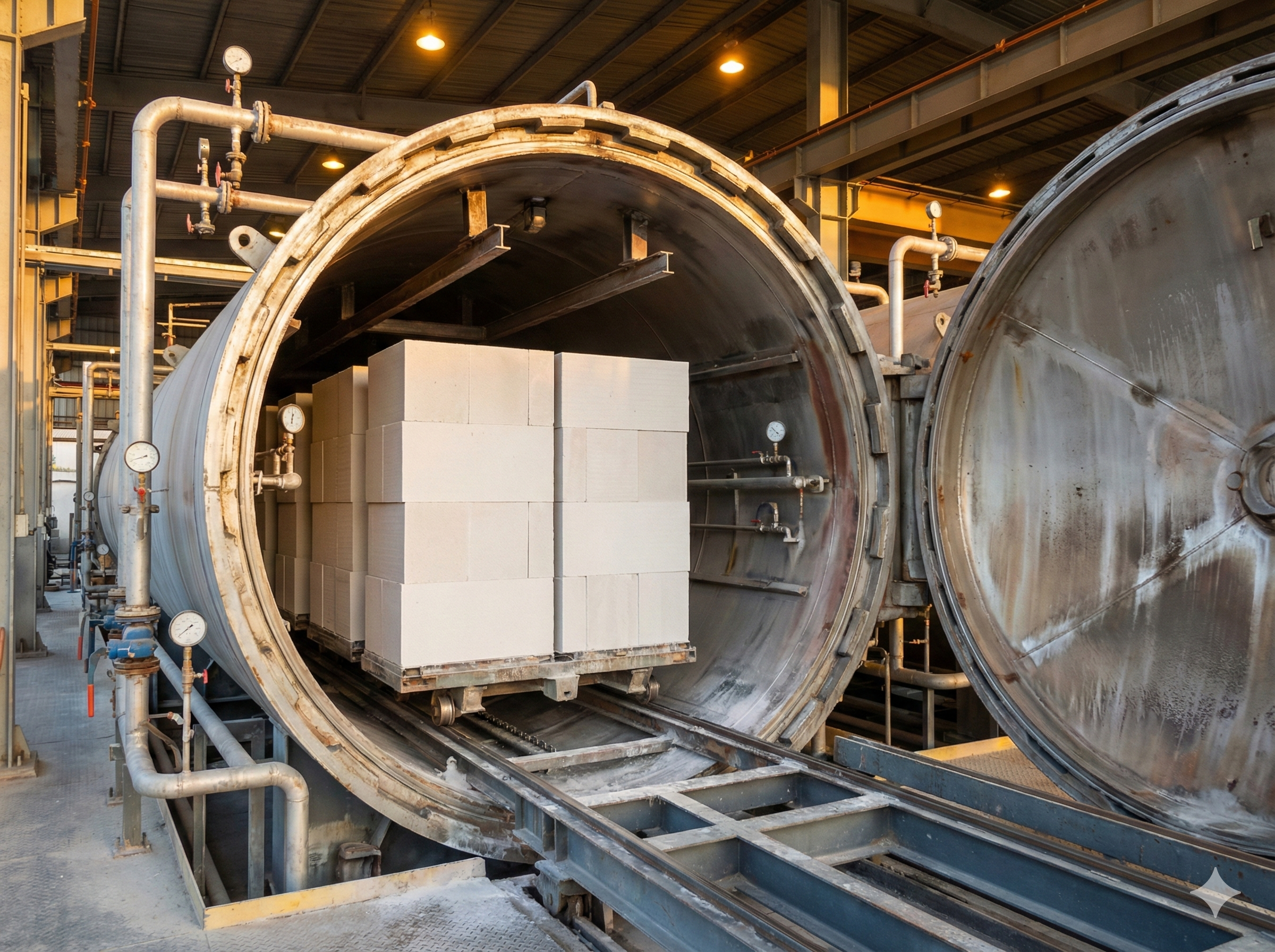
Autoclaving - The Critical Step
Blocks undergo approximately 12 hours of high-pressure steam curing to develop final strength and stability.
Equipment
Industrial autoclaves, windlass, steam generation system
Output
Fully cured, hardened AAC blocks
De-molding & Storage
Cured blocks are unloaded, palletized, wrapped, and moved to covered storage for dispatch.
Equipment
Windlass, forklifts, storage yard
Output
Finished AAC blocks ready for sale
Mold Returning & Oiling
Molds and plates are cleaned, oiled, and returned to production for the next cycle.
Equipment
Mold returning rail, cleaning system, oiling machine
Output
Clean, oiled molds ready for reuse
Why Autoclaving Matters
Autoclaving uses high-pressure steam curing to transform AAC and lock in structural performance and durability.
ISO-Grade Production Controls
Batching Precision
Electronic scales measure every ingredient to high accuracy.
Wire-Cutting Accuracy
Factory-controlled cutting tolerances ensure dimension consistency.
Autoclave Monitoring
Continuous pressure and temperature tracking throughout curing.
Experience the Difference
Schedule a plant tour to see our AAC production line in action at APIIC Mydukur, Kadapa.